

Edinburgh’s narrow, historic streets face increasing pressure from large and heavy vehicles, which accelerate wear and tear and reduce available street/parking space. Current parking charges do not reflect the environmental or spatial impact of different vehicle types, limiting the city’s ability to incentivise smaller, low-emission vehicles. As part of Edinburgh’s ambition to achieve net zero by 2030, the City Council has committed to reducing car trips within the city by 30%. Therefore, it is essential to manage car impact through smarter policies.
The UK’s Driver and Vehicle Licensing Agency (DVLA) database contains rich vehicle information (e.g. emissions and weight), which could support better on-street parking management. The data, however, is not readily attainable by parking enforcement, with questions over compatibility with the various systems used to manage parking across the city. As a result, the current management system Pay & Display does not allow automated linking of vehicle attributes. This results in a one-size-fits-all pricing model that fails to reflect the environmental and spatial impact of vehicle types.
Combining DVLA data with technology-driven back-office processes offers an opportunity to introduce fair, evidence-based parking charges that align with sustainability objectives, protect heritage streets, and optimise limited urban space.
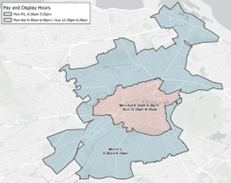
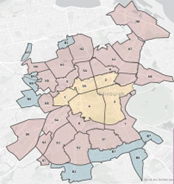
Area: Areas of the city that are covered by parking controls (generally around the city center where demand for parking is highest).
Pay and display parking areas: Resident parking zones:
DESIRED SITUATION
By implementing and enforcing differential parking charges, based on vehicle attributes, the project aims to:
- Achieve a 5% reduction in large/heavy vehicle parking, within the current controlled parking area, across the lifespan of the project.
- Measure the absolute area saved by the reduction in vehicle size, in m2, on a sample street, before and after implementation.
- Reduction in the number of higher emission vehicles parking in the city centre streets.
- Reduce the processing time of parking charge calculations to the point that it is feasible to implement and enforce Pay & Display parking across various vehicle types.
