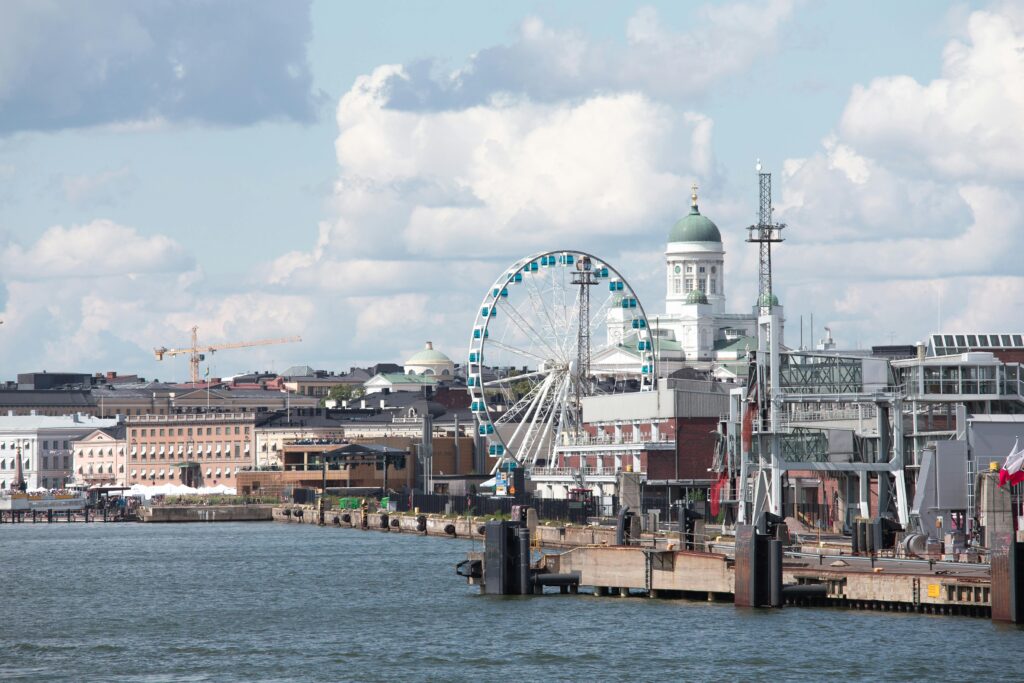
Helsinki

Challenge
How can Helsinki use professional fleet vehicles as a data collection platform?
CURRENT SITUATION
Today, data collection in Helsinki is carried out as separate, stand-alone missions. This approach generates unnecessary traffic, increases operational costs, and typically captures only one type of data at a time. As a result, data collection processes are often inefficient, inflexible, and poorly suited to the complexity of urban environments.
The city currently relies on static sensors, manual counting, and occasional large-scale street scanning to obtain information about traffic activity and infrastructure. These methods are slow to implement, expensive to maintain, and unable to adapt easily to changing urban conditions. Scaling static monitoring adds further cost pressures, while manual counts, still used for traffic and parking occupancy, limit the quality and frequency of available data.
Helsinki sees potential in using existing professional fleets as mobile sensing platforms. Public transport vehicles, maintenance vehicles, or logistics fleets already circulating in the city could gather multiple types of data simultaneously without generating additional traffic.
This would allow Helsinki to build a more dynamic and accurate picture of street-level conditions and improve the city’s ability to manage its urban environment.
Area: city centre of Helsinki
DESIRED SITUATION
Fleet vehicles* equipped with a data collection system move through the city and capture several types of urban data at the same time. Success is defined by the system’s ability to deliver the following outcomes:
- Successful detection of road users, including both stationary and mobile, cars, LCV, pedestrians, and bicycles. Used for improving VRU safety, estimating traffic density and parking space occupancy.
- Successful mapping of infrastructure assets like curb stones, street markings, traffic signs, etc.
- Successful change detection in urban street space (e.g. infrastructure changes)
It is encouraged that the data collection system uses multiple positioning methods, like visual positioning, in addition to GNSS positioning due to GNSS interference in the region.
*For example, public transport, city maintenance, and/or logistics vehicles.
Forum Virium Helsinki is responsible for arranging collaboration with local fleet owners.